Washing the dishes to wash the dishes
A shift in perspective on one of life’s endless daily tasks.
June 2025
Living room pandemonium is an everyday occurrence. Toys everywhere, a watch buried in the couch cushions, books strewn about, bookmarks stripped of their page-saving purpose. A day in the life of a toddler is defined by free-wheeling love and intuitive mayhem. And of course, a sink full of dishes to clean — dishes that involve taking socks out of a bowl on the kitchen floor.
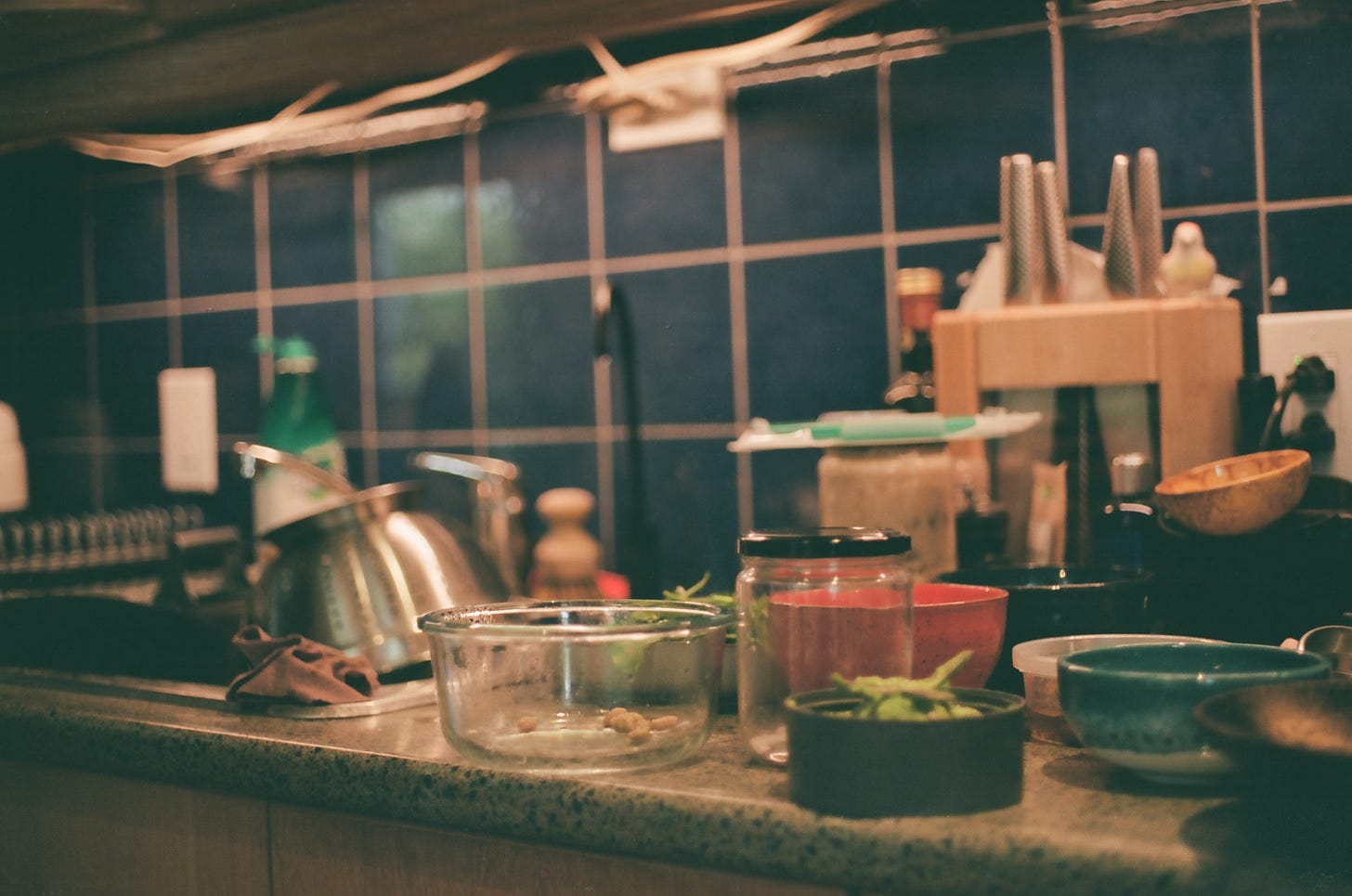
There’s no avoiding it. No magic spell to cast on my home or prayer to offer up to the heavens. Every day, the kitchen sink fills with stuff. Even after the kitchen is cleaned to its baseline state, a few hours pass, and it’s en route to full again.
A few days ago, I cleaned a pot with tomato sauce that had been there for a day. Oily water overflowed from the pot and coated everything else in the sink with a stubborn slickness. I became Sisyphus pushing the boulder up the hill; I washed and washed and washed.
The temptation to ruminate and daydream about anything and everything pulls at my ankles like a riptide. A sink full of dishes, baked into my head as a chore to be completed so I can get on to more important things. It’s so tantalizing to frame mundane everyday tasks as obstacles in the way of real “living.”
That’s why dishes are the focal point of many-a-teaching in Buddhist philosophy: when you wash the dishes, wash the dishes.
A monk said, “I have just entered the monastery. Please teach me.” The master said, “Have you eaten your rice porridge?” The monk replied, “Yes.” The master said, “Then go wash your bowl.”
My time in India introduced me to the concept of karma yoga, the path of action and selfless service. I learned that there is yoga in household tasks. One retreat in Rishikesh had us crawling on all fours in the shala to scrub the floors each day. It wasn’t exactly the teaching I was after at the time, but something is starting to click into place.
This is the essence of mindfulness in everyday life. The practice, the path, lives and breathes in the mundane. Seeing the dishes as an obstacle to what really matters is a ticket to a chore-filled hamster wheel for the rest of my days. Or, I can let it go and wash the dishes with, dare I say, reverence.
The reality is that I’m blessed to live in a home, and that home needs care and stewardship. Cleaning, putting things back in place, being aware of space and clutter… everything contributes to a sense of well-being and ease. Each act of care for our home environment is an act of love for my family. How can I make that feeling come alive every time I pick up the sponge?
I did some math. If I assume spending 20 minutes per day cleaning dishes, over 50 years, I’d end up spending 380 full days of my life standing at the kitchen sink scrubbing, rinsing, drying, and putting things away. That’s a lot of time — a lot of time that could be spent waiting, wishing, daydreaming myself out of the present moment.
So I’m in the process of shifting my perspective. The dishes aren’t a task to be completed but part and parcel of what it means to cultivate a thriving, healthy living space.
A pause helps. Three breaths, slow and deep. It’s not foolproof, but that snippet of space helps me arrive before I turn on the faucet.
This daily task isn’t something to sigh about, not a burden weighing on my back—it’s a thread in the weave of love. Each clean dish is a gift to myself and my family.
Similar to the waiting room, the kitchen sink is a dojo-in-waiting. It’s an opportunity to appreciate what it means to have dishes in a sink to be cleaned, food in our bellies; to have a kitchen, a roof, and sealed windows to shield us from the hearty rip of a summer storm.
Doing the dishes is tending to the garden, and as Thich Nhat Hanh says, there’s only one way to wash dishes: “to enjoy washing dishes.”