I found a half-eaten tomato under a tree
Everything I know as “me” will one day inhabit an unseen world pulsing with unfathomable vivacity.
June 2025
I took this photo in Laurier Park, one of my favorite places to trace footsteps and ruminate. A gloriously ripe tomato became a squirrel’s meal; saved for later or abandoned, I couldn’t say. Either way, someone is going to eat it. That squirrel may have a full belly, but legions of smaller and smaller beings are only getting started.
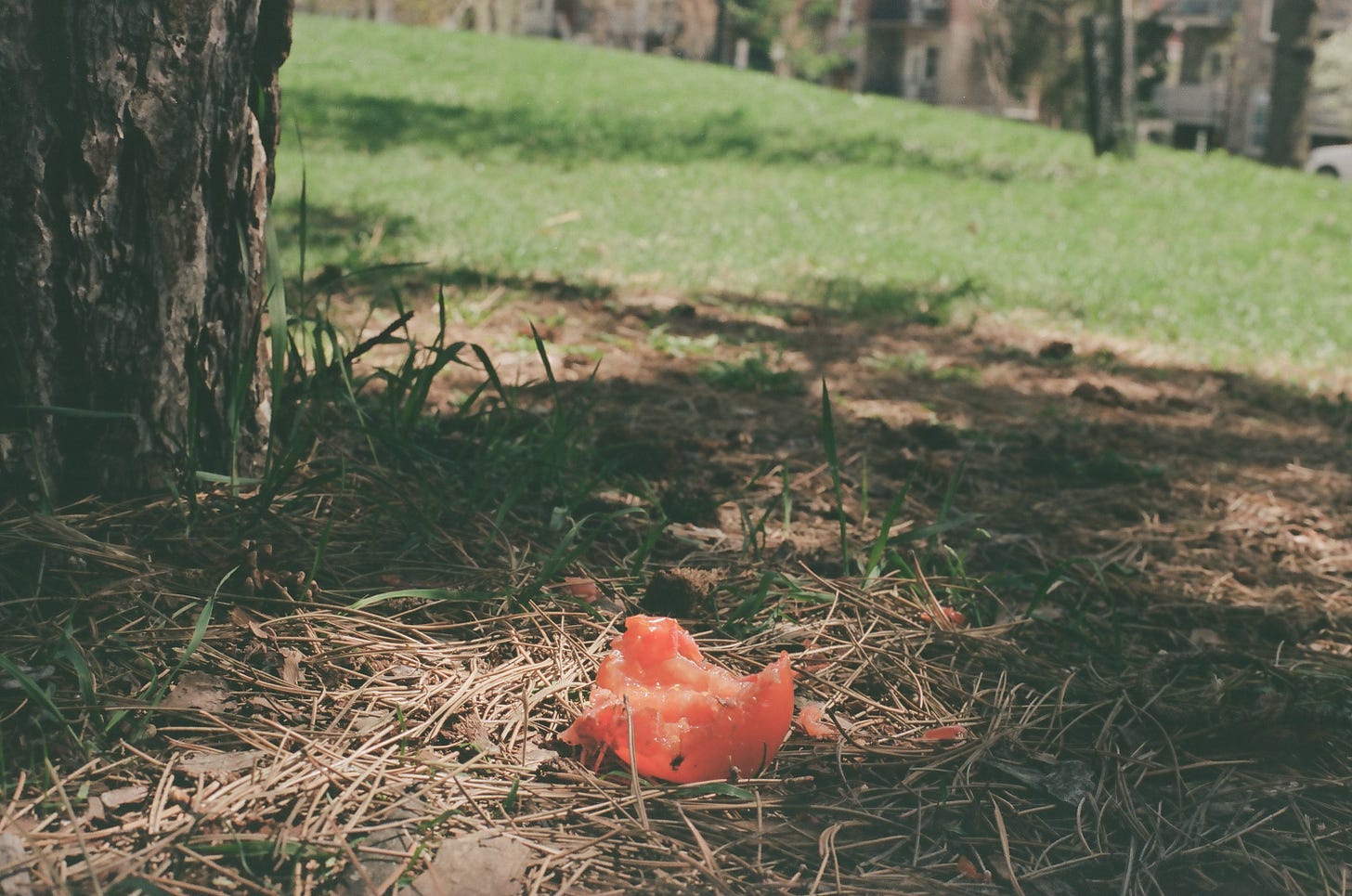
The whole dance crescendos quickly. An ant colony begins to organize its assembly lines once the first scout gets a whiff of tomato from the grass. Microbial communities buzz, leech, and bind to it. A lone grasshopper may hop by for a curious lick.
It’s only a matter of time before this tomato dissolves in the belly of the earth to metamorphose into thousands of other beings, bacteria, and fungi. If you buy a ripe tomato, place it on the ground, and watch it for several weeks, it will completely and utterly disappear.
The peculiar thing is that the essence of the tomato—the energy suspended in its cells—doesn’t vanish into thin air. It transforms. The tomato becomes a squirrel, becomes hard-working ants, becomes a mycelial thread, becomes a puff of dust in the wind. What we pluck off the vine and experience for a time as a “tomato” becomes 10,000 other beings. Where do “I” begin and end?
Thirty spokes converge upon a single hub;
It is on the hole in the center that the use of the cart hinges.
_We make a vessel from a lump of clay;
It is the empty space within the vessel that makes it useful.
We make doors and windows for a room;
_But it is these empty spaces that make the room livable.
Thus, while the tangible has advantages,
It is the intangible that makes it useful1.
If I become aware of my body, what is it I’m becoming aware of? A particular form with particular borders, edges, and sense perceptions; a mind thinking thoughts and feverishly writing them down. A driving pulse. An itch. A sore oblique muscle.
I recently read about a Bacillus spore bacteria that was revived after being dormant for 250 million years—how can I even begin to wrap my head around that?
Something encoded deep into its strands of DNA was “brought back to life” after an unthinkable amount of time. But to me, “revived” seems too anthropocentric. We humans like to imagine that we have the power, intelligence, and control to bring something back from the dead.
But the essence of life—the basic coding that rouses the deep slumber of a bacterium—never left it. It simply waited for the right conditions to emerge and weave back into the throng for another round on the planet.
The earliest dinosaurs roamed the Earth ~240 million years ago, during the Triassic Period. Does this bacillus spore hold a memory of that time? Does it know what it’s like to live inside a bone? Did it feel the apocalyptic impact of the 10-kilometer-wide asteroid that ravaged the Earth 66 million years ago and caused all the dinosaurs to go extinct?
The term “food waste” comes to mind—another anthropocentric term. Humanity should absolutely share all food and be compassionate to our fellow humans. And, no food is ever truly wasted.
Every bagel in the back alleys of this city is quietly feasted upon by billions of microbes multiplying in the shadows of these streets. As the saying goes, one man’s trash is another man’s treasure.
A heap of compost thrives with vivaciousness; it’s a hot pile of consumption, combustion, growth, buzz, and decay. All these micro beings make possible the sustenance that ends up on our plates. Meanwhile, other species live and thrive in our guts to help us digest the cultivated nutrients too. It’s an unbelievable symbiosis.
I’m baffled by the resilience and gusto of this 250-million-year-old bacterium.
That bacillus spore is alive, just as I am alive. My body is home to trillions of microorganisms that influence my behavior, my health, and my thoughts. A single gram of food ingested contains ~1 million microbes2, and what I eat determines which species thrive in the 30 feet of digestive plumbing suspended in my abdomen.
When a family moves into a new home, it becomes populated with the family’s microbiome in 24 hours3. Bacteria live around, among, and within us, forming the ecosystem of the body—this body, which I call “my body.” Where do “I” begin and end?
Eventually, even memories “vanish” like tomatoes under trees; they turn to ghosts in the halls of our homes, hidden to the naked eye. Fungi, hordes of bacteria and microbes, insects—the arbiters of the transition—will eat us all to dust and carry our essence onward. Everything I know as “me” will one day inhabit an unseen world pulsing with unfathomable vivacity.
Voracious, incessant—this microscopic realm survives even asteroidal ecosystem collapse.
And it will continue to survive these celestial calamities, again and again. Perhaps the next event will send some of our Earthly microbes cascading out through space in search of a new floating rock to call home, for new beings to populate, nourish, and feed on.
A new beginning of an old, old story.
-
Tao Te Ching, Chapter 11: translated by John C. H. Wu ↩︎
-
Source for this wild stat: https://www.sciencefocus.com/the-human-body/human-microbiome ↩︎
-
Source for this wild stat: https://www.nationalgeographic.com/science/article/we-constantly-imprint-our-homes-with-our-microbes ↩︎