Hope and resilience in uncertain times
“Everything can be taken from a man but one thing: the last of the human freedoms — to choose one’s attitude in any given set of circumstances, to choose one’s own way.” — Victor Frankl
February 2026
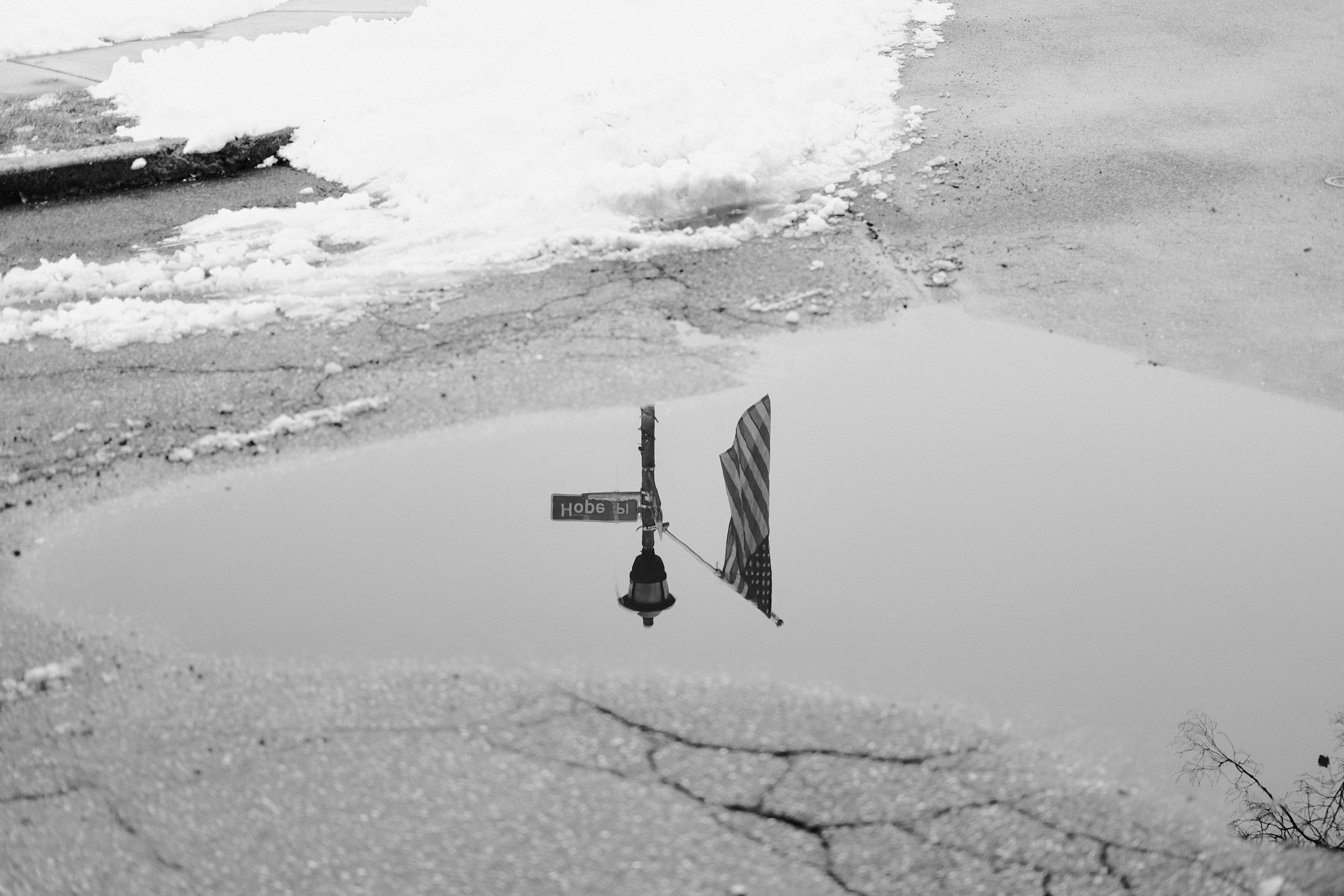
I took this photo over the holidays, walking around the neighborhood on Long Island where I grew up. The image struck me instantly: a puddle reflecting a somber American flag hanging from the street sign — Hope Place.
This recent stretch of time has reminded me that all the information I consume (an apt word) is digested by my body.
If I’m only taking in darkness, then I’m only infusing my cells with more darkness. If I hold anger / fear / resentment, those states manifest in my body and ripple out to everyone I’m in contact with. I walk the streets and sprinkle bits of darkness around; I make soup, and some dark spices inadvertently slip into the pot. It means that I play a role in creating a more angry, fearful, and resentful world.
Staying informed about what’s happening in the political / ecological zeitgeist needs to be balanced with practicing joy and gratitude. I can’t let the tumult of our time take away from my capacity to revere and celebrate the beauty and mystery of life.
Plus, it’s all just too much to take in at once. I’m old enough to remember the days when my Facebook feed (consumption consumption consumption) was only posts from my friends. Having 24/7 access to the IV drip of what’s happening is a recipe for overwhelm, hopelessness, and burnout. It doesn’t serve me; it doesn’t serve anyone. Our nervous systems haven’t evolved fast enough to process the flood of it all. At the end of the day, I shouldn’t have to scroll through violence, unrest, and advertisements to get to my friends’ posts about their artwork, upcoming events, or celebratory family moments.
I have to face the reality that a part of me is addicted to the emotive quality of current events. It’s visceral, impactful, intense, and biologically stimulating. This part of me is seduced by information and the need to be informed about what’s happening. Is it so I’m ready to act? So I don’t miss out? So I have an opinion to share?
Then there’s another part that reminds me that I’ve forgotten to pause, get outside, and fill my lungs with fresh air. That part reminds me to appreciate and be grateful for my life. It reminds me of integrity — staying true to my values and doing what’s right for myself, my family, and my community.
As Jack Kornfield says, Tend to the part of the garden you can touch.
I do feel a sense of responsibility to be informed about worldly affairs — especially the country of my roots, the United States. But my digestion of information has to be balanced with nourishment of my heart and mind. I fell out of balance recently, and the algorithms caught me hook, line, and sinker.
What we do with the information we’re taking in matters. Does it plant seeds of resentment, anger, despair, hopelessness? If it does, it means that I have the burden of carrying it. And again, it goes beyond me to everyone I interact with. In remembering my connection to the wider world and its people, plants, animals, microbes, I remember that what I consume — information or food — becomes my body and mind. You are what you eat.
Eat darkness, you become darkness.
Eat kindness, you become kindness.
I don’t think blissful ignorance is the answer. So, the question I’m holding: can I be a witness to the world, stay informed, and take compassionate action without the negativity and vitriol seeping into my cells? The right balance is hard to strike when there are such powerful forces to contend with, pulling at the strings of my biology.
Still, I have to look in the mirror each day and honestly ask myself: Which wolf are you feeding?
The Case for Optimism
With all the upheaval, vitriol, and injustice, it’s easy to succumb to hopelessness. After all, that is what the algorithms are feeding us 24/7. We’re in the midst of turbulent, uncertain times, and that turbulence is being amplified. But we can’t let that squeeze out and mute the possibility of a brighter, more compassionate world. That possibility dwells in each and every one of our hearts.
Hope is keeping the door open to possibilities. Losing hope means giving up; it means closing the door on the possible.
Kevin Kelly2 is a man who wears many hats, one of which is being an optimist. I don’t necessarily agree with his vision of the future, but his mindset and willingness to focus attention on positive futures have inspired much reflection on where I’m placing my energy. The other day, I saw that he has a new podcast called Best Case Scenarios3 which brings knowledgeable guests on to discuss the best-case scenario for the world in different fields / topics. They’re looking at a 25-year time horizon.
It feels radical — and totally against the tide — to practice dwelling in the highest outcome for humanity and this earth. But not only is it absolutely possible, but it’s also necessary fuel for ushering in a brighter world.
“It is extremely difficult to create a desirable future without first envisioning it. To imagine is really the first step in creating anything. Therefore an essential chore for making a future we want to live in, is to imagine what it is like and how we get there. That plausible path is a form of optimism. Believing it is possible makes it more likely to happen. When hurdles and setbacks arise – and they will – the belief in its possibility serves as motivation. History is filled with accounts of people who held an optimistic belief others thought unlikely, or even impossible. This optimistic previsualization is a necessary component of change. Since we can not be certain of the future, optimism is only a belief – a stance that could be incorrect. On the surface, an optimistic belief might seem no more valid than the stance of pessimism. But the deep history of new ideas makes it very clear that the optimistic stance of believing something is possible is a requirement to make anything new real, and is thus more powerful than pessimism. In the long run, optimists shape the future.” — Kevin Kelly
Once we lose hope, we lose the magic of our creative potential. Hope ensures that we have dormant seeds sprinkled throughout our imaginative landscape waiting for the right conditions to sprout and poke through the dark soil. Then, with great care, those seeds can grow into mature plants that bear sweet, sweet fruit.
By anchoring attention to what’s possible, and holding higher outcomes in our collective vision, doors will begin to open. Opportunities reveal themselves. The world around us is shaped by the quality of our attention.
In Victor Frankl’s book Man’s Search for Meaning he observed that the prisoners who felt their lives still had meaning were more likely to endure the brutality of the concentration camp on an emotional and psychological level. Those who had given up, who had lost their sense of meaning and hope, declined more rapidly.
“Everything can be taken from a man but one thing: the last of the human freedoms — to choose one’s attitude in any given set of circumstances, to choose one’s own way.”
Every morning, I wake up with a fresh opportunity to choose my path for the day. Each choice cascades into the next and sets the tone for what’s to come. Where I place my attention and energy creates the life that I live and the world that is reflected back to me; the world that I co-create alongside you.
We are the architects of the future, and everything we do matters. Every footstep leaves an imprint behind.
So let this be my vow in writing: I will not give up hope.